
How to Search Alger County Court Records
Alger County does not run one branded court records portal. The state carries most of that load. Michigan's MiCOURT case search is the main public gateway for trial-court and appellate case lookups. It lets you search by case number, party name, attorney name, or bar number. You can also filter by lower court, which includes Alger Circuit Court, Alger Probate Court, and the district court that serves the county. For older files or paper records, the county clerk and the court that opened the case are the fallback path.
Gather a few details first. A full name, a rough date, or a case number all speed the search. The Michigan Courts case search is free to use and open to the public.
- Open the state case search at courts.michigan.gov or the MiCOURT case search page.
- Type a party name or a case number into the main search box.
- Filter by lower court to narrow results toward Alger County.
- Choose a result type, such as cases, opinions, or orders.
- For a full file or a certified copy, contact the clerk or the court that holds it.
The public web view is narrower than a full case file. A statewide directory of every trial court sits on the Michigan trial courts page, which helps confirm which bench heard a matter.
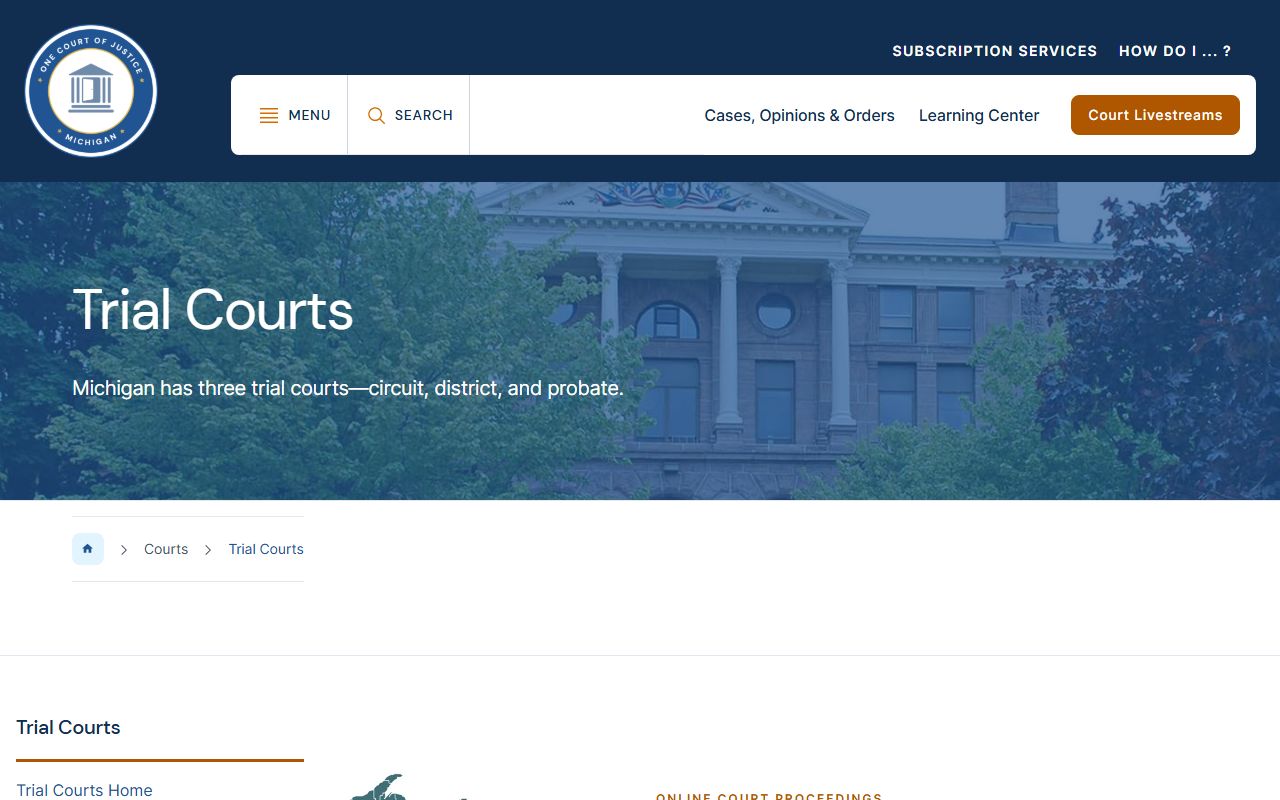
That state overview shows how local courts feed into the wider Michigan system. It also points readers to the right court desk when a file is not online.
The Alger County Judicial System
Michigan gives Alger County three trial-court channels. The 11th Judicial Circuit Court is the main trial court. It hears felonies after bindover, large civil suits, and family division matters. The 93rd District Court handles misdemeanors, traffic and civil infractions, small claims, evictions, bail, and the first steps of felony cases. The Probate and Family Court oversees estates, guardianships, and juvenile matters. Appeals move up from there.
The judge for the 93rd District Court is Hon. Charles C. Nebel, who serves both Alger and Schoolcraft Counties. Scott Smith is listed as the Alger County magistrate. The district court runs two offices, one in Munising and one in Manistique, so the same court spans county lines. Alger County has no separate justice court or city court, which keeps the map simple.
Case flow: District Court or Circuit Court › Michigan Court of Appeals › Michigan Supreme Court
| Court | Jurisdiction | Case Types |
|---|---|---|
| 11th Judicial Circuit Court | Primary trial court, Alger County | Felonies after bindover, major civil, family division |
| 93rd District Court | Alger and Schoolcraft Counties | Misdemeanors, traffic, small claims, evictions, bail |
| Probate and Family Court | County probate court, Munising | Estates, guardianships, adoptions, juvenile matters |
| Michigan Court of Appeals | Statewide appellate court | Appeals from circuit and district courts |
| Michigan Supreme Court | State court of last resort | Final review of state cases |
The county courts overview lays out these offices in one place. A quick look at the Alger County courts page confirms which desk handles a matter.
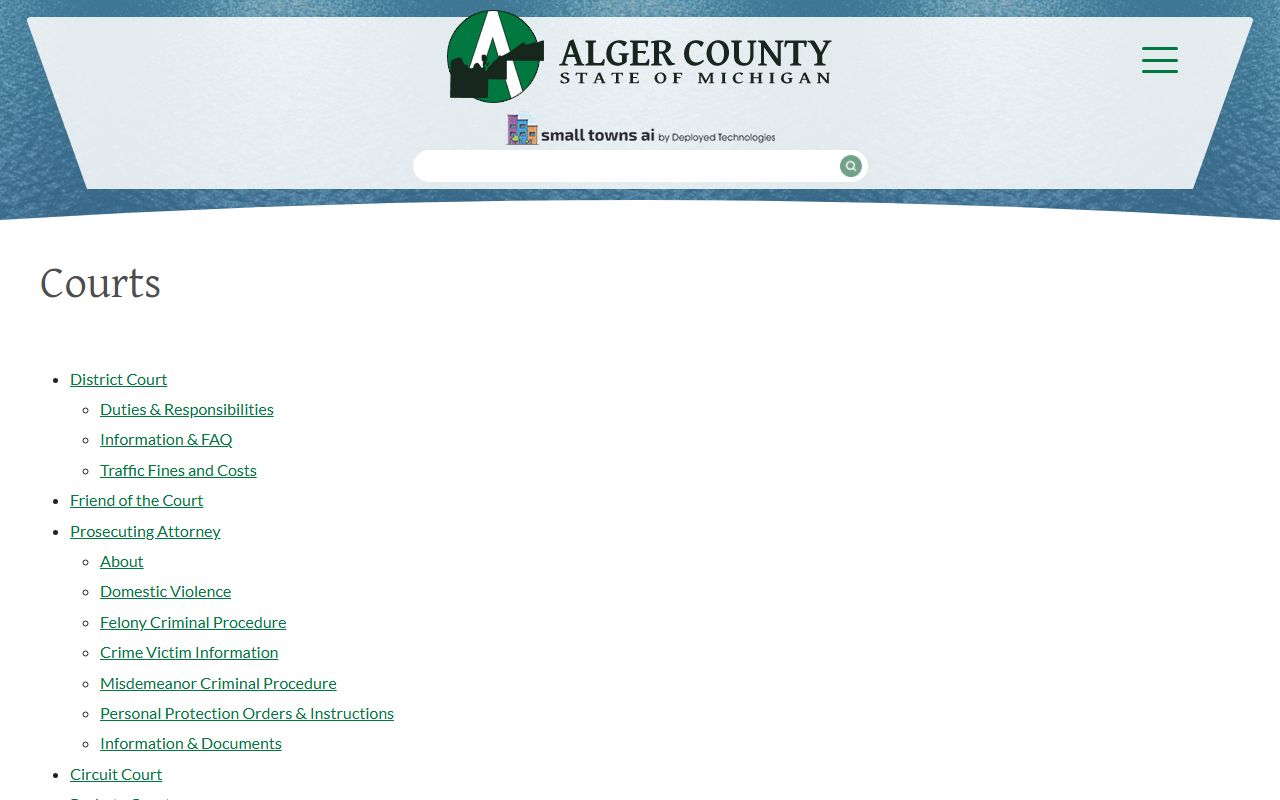
That overview links out to the circuit, district, and probate desks. It is the fastest way to match a case type to the right local court.
Types of Court Records Available in Alger County
The county keeps no single master list of record types. The set comes from the circuit, district, probate, clerk, and sheriff pages. Most public requests fall into a handful of clear groups. Each group lives with the court or office that made it.
Some files are open to anyone. Others are sealed or held back by rule. The list below shows the main record types and where each one sits.
- Criminal records - misdemeanors in district court and felonies in circuit court after bindover.
- Civil records - suits up to $25,000 in district court and larger claims in circuit court.
- Family and divorce records - divorce, custody, paternity, and support in the family division.
- Probate records - wills, estates, guardianships, and conservatorships.
- Traffic records - civil infractions and misdemeanor traffic cases in district court.
Juvenile records form a separate group and are mostly restricted. The county home page frames Alger as the heart of Michigan's Upper Peninsula, and its portals point to each record type.
The Alger County home page gathers the main service links in one spot. From there a reader can reach court, clerk, and payment tools.
What Alger County Court Records Show
Michigan court files follow a shared structure. Each case is built around a case number and a running history. A record usually shows the parties, the filing dates, the hearings, the orders, and the outcome. Public web views often show only case metadata, not full document images.
State standards set what the public web portal can display. They limit the online view to case number, party names, and case history. To read the full file, a person may still need to visit the clerk or the court. The table below breaks down the common fields.
| Field | What It Shows |
|---|---|
| Case Number | The unique code that tracks the case, such as CV, CR, FM, PR, or JV. |
| Filing Date | The date the complaint, citation, or petition was filed. |
| Parties | The plaintiff or state and the defendant, plus listed attorneys. |
| Charges / Cause | The charge, the claim, or the reason the case was opened. |
| Disposition | The result, such as a plea, a dismissal, or a judgment. |
| Sentence / Judgment | Fines, costs, restitution, probation, or the money owed. |
Money fields matter as much as the charge. Fines, costs, and bond amounts all sit in the file, and the county lets people pay many of them online through the county payment portal.
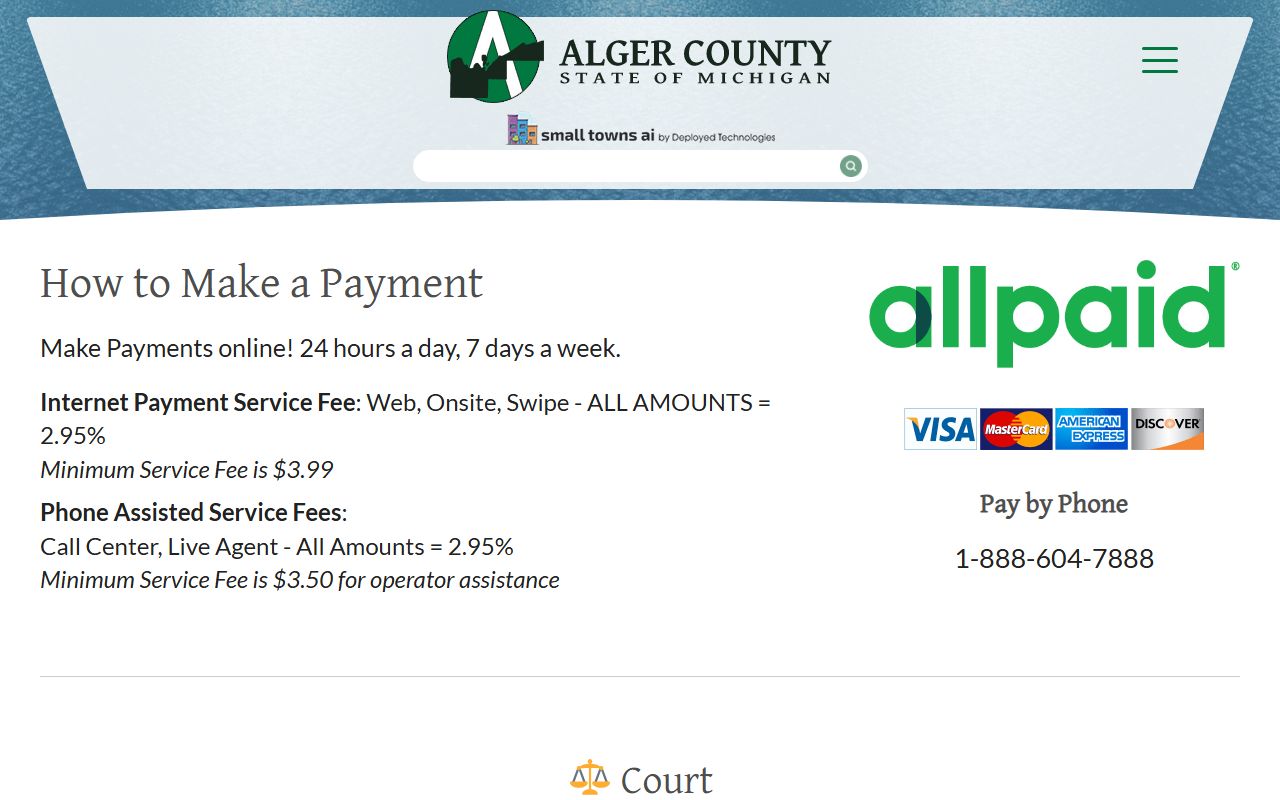
That payment page ties a court obligation to a paid receipt. A cleared balance often shows up in the case history soon after.
Records That Are Restricted or Confidential
Not every file is open. Some records are sealed, and some are closed by law. The most common restricted groups in Alger County are juvenile files, adoption files, and mental-health commitment records. A search page that shows nothing does not always mean the case does not exist.
Juvenile matters are the clearest example. Delinquency, neglect, abuse, foster care, and youth diversion all sit on the juvenile side of the probate court. Those files are usually not open the way adult cases are. Adoption records and commitment records carry similar limits and often need court permission to view.
Expungement is the main route people use to clear an adult criminal record. Michigan calls it a set-aside. The steps run in order.
- Confirm the record is eligible under Michigan's set-aside law.
- Pull the case details from the court that handled it.
- File the set-aside paperwork with the sentencing court.
- Serve notice on the prosecutor and the listed agencies.
- Attend any hearing the court sets.
- If granted, the record is set aside and no longer treated as public.
Clerks and court staff can explain the local filing path. They cannot give legal advice, so many people ask a lawyer before they file.
Searching Alger County Cases Through MiCOURT
MiCOURT is the state's case management and search system. Its public search page is built for more than casual use. Attorneys, parties, and reporters all rely on it. The tool can surface Alger County matters at the appellate level, and one sample result, Irene Mercier v County of Alger, came up through the Court of Appeals view.
The search page carries several controls. The table below lists the main fields and how they work, so a first-time user knows what to expect.
| Field or Control | Type | Notes |
|---|---|---|
| Search box | Text | Searches cases, opinions, and orders |
| Appellate court | Filter | Supreme Court, Court of Claims, Court of Appeals |
| Lower court | Filter | Alger Circuit Court, Alger Juvenile Division, Alger Probate Court, District Court |
| Case type | Filter | Narrows results by matter type |
| Result type | Filter | Cases, Opinions, or Orders |
| Page size | Dropdown | 10, 25, 50, or 100 results |
| Sort | Dropdown | Relevance, alphabetic, newest, or oldest |
The system shines for appeals and published opinions. It is not a full local docket viewer. For daily calendars and non-digitized files, the district court and clerk remain the better local contact.
Note: Court records in Michigan are not FOIA records, so a public search view may show case history without the full document images behind it.
Public Access Laws for Alger County Court Records
Two different rulebooks govern access in Alger County. County office records fall under Michigan's Freedom of Information Act. Court case files fall under Michigan court rules instead. That split explains why a clerk may answer a records request one way and a court another way. The Michigan trial court records standards spell out the court side.
Key Statutes:
MCL 15.231 - States Michigan's FOIA policy that people are entitled to information about their government.
MCL 15.233 - Sets how a public body receives and answers a written records request.
MCL 15.234 - Controls the labor, copy, and mailing fees a public body may charge.
MCL 15.243 - Lists the records a public body may withhold or redact.
MCR 8.119 - The court rule making trial-court records public unless a rule or order restricts them.
MCL 780.621 - Michigan's set-aside statute for clearing an eligible criminal record.
The practical takeaway is simple. Open files can be inspected or copied through the clerk or the court. Sealed, juvenile, or set-aside files stay closed, and a requester may only get a redacted copy. For anything not online, an in-person, mail, or FOIA request to the office that holds the file is the standard backup.
Alger County Court Types Compared
People often mix up the district court and the circuit court. The two handle very different work. A quick side-by-side clears up which bench a case belongs to. The probate court adds a third path for family and estate matters.
| Feature | 93rd District Court | 11th Circuit Court | Probate / Family Court |
|---|---|---|---|
| Criminal reach | Misdemeanors and felony first steps | Felonies after bindover | Juvenile delinquency |
| Civil limit | Up to $25,000 | Large civil claims | Estate and guardianship |
| Family work | Some infractions | Divorce and custody | Adoption, paternity, PPOs |
| Other | Small claims, evictions, traffic | Appeals from district court | Wills held for safekeeping |
A misdemeanor, a small claim, an eviction, or a traffic ticket starts in district court. A felony trial after preliminary examination moves to circuit court. A will, a guardianship, or a name change belongs in probate. That routing saves a wasted trip to the wrong desk.
Note: Because the same district court serves both Alger and Schoolcraft Counties, a case search can surface a court reference that spans two counties at once.
Alger County Sheriff and Jail
The Alger County Sheriff's Office sits at 101 E. Varnum Street in Munising, apart from the main courthouse. Sheriff Todd Brock leads the office, and the phone line runs 24 hours a day, seven days a week. The office includes the Alger County Jail. Marc Maxon serves as jail administrator for booking and jail-operations questions.
The sheriff does not publish an online jail roster on the county pages. For state prisoners, parolees, and probationers, the Michigan Department of Corrections OTIS system is the public tool. The county also links JailATM for inmate money deposits. Full booking and custody details for Alger County inmate records live on the jail roster page, while active warrant records route through the sheriff, district court, and prosecutor.
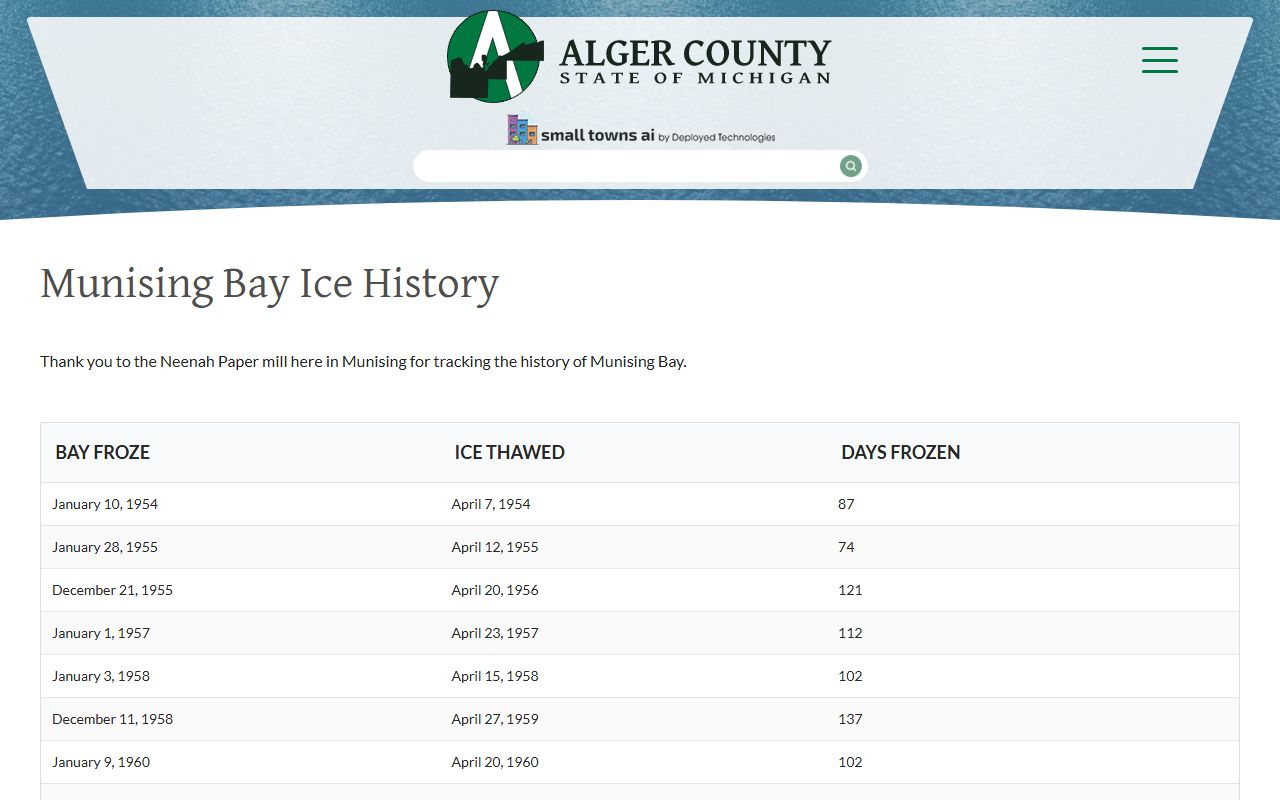
Munising is the county seat and a working harbor town, which is where local law enforcement is based. Its Munising Bay history reflects the tight, single-seat layout of county offices.
Marriage, Divorce, and Probate Records
Marriage and divorce records live in two different offices. The county clerk keeps marriage licenses and certified marriage copies. Divorce case files sit with the family division and the circuit court. That split trips up many searchers, so it pays to know it up front. Details on both appear on the marriage and divorce records page.
Probate covers wills, estates, guardianships, and conservatorships. The county probate court also holds adoption, juvenile, and family matters. Many of those files are restricted. The full picture sits on the probate records page. A short glossary helps with the common probate terms.
- Testator
- The person who made a will.
- Executor
- The person named to carry out a will.
- Conservator
- A person the court names to manage another's money or property.
- Intestate
- Dying without a valid will, so state law sets who inherits.
The clerk is also the county's marriage-license hub. Both applicants must be at least 18 and must show a government photo ID at pickup.
Alger County Court Records Fees
Fees in Alger County depend on the service, not on a flat per-page court charge. The clerk sets vital-record copy fees. The register of deeds side sets property-search fees. The sheriff collects the fingerprint fee for a concealed pistol license. The table gathers the published amounts in one place.
| Item | Amount |
|---|---|
| Vital record, first certified copy | $15 |
| Vital record, each added copy of the same record | $5 |
| Tapestry property search | $8.75 per search |
| Tapestry image copy | $1.00 per page |
| Concealed pistol license, new | $100 |
| Concealed pistol license, renewal | $115 |
| Concealed pistol license, reprint | $10 |
| CPL fingerprinting, paid at the sheriff | $15 |
| Civil marriage ceremony | $10 |
Vital records can be ordered in person, by mail, or online with a signed form and a photo ID. Property searches run through the county's online property records access tools, where Tapestry serves casual users and Laredo serves frequent ones.
How to Read Alger County Court Records
Court files use shorthand that can confuse a first-time reader. A case number often starts with a code for the case type. The docket then lists events in plain but clipped language, such as arraignment, plea entered, or order entered. Knowing a few terms makes the file far easier to follow.
One point matters more than any other. A charge is not the same as a conviction. A charge is what the state filed. A conviction is what the court found true. A dismissed or set-aside case should never read as a conviction.
- Plaintiff
- The person or entity that files a civil case.
- Defendant
- The person sued or charged in a case.
- Arraignment
- The first hearing where charges are read and rights explained.
- Bindover
- The transfer of a felony from district court to circuit court.
- Disposition
- The outcome of a case or a charge.
- Bond
- Money or a promise posted to secure a court appearance.
When a docket entry is unclear, the clerk can explain what a code means. Staff can point to the record without offering legal advice.
Accuracy and Record Limitations
Online records lag behind the courthouse. A hearing, a payment, or a new order can take days to post. The public web view also shows less than the full paper file. For a high-stakes need, the office that holds the record is the safest source.
Court access can also shift with the calendar. The courthouse schedule lists holiday and election-day closures, and weather closures have happened in the recent past. A quick check before a visit avoids a wasted trip during a posted closing.
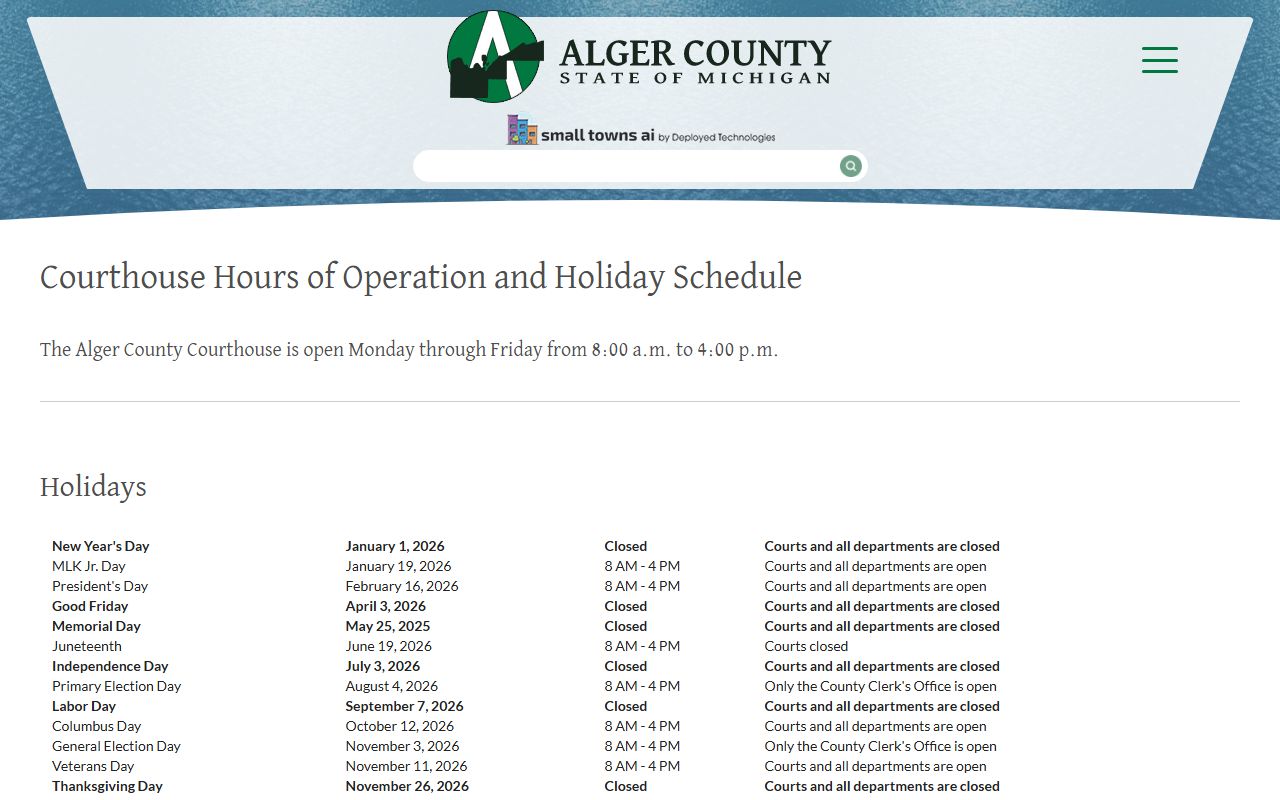
The courthouse schedule page shows which offices stay open on special days. On election days, the clerk may be open while the courts are closed.
Note: Always confirm a date, a charge, or a balance with the clerk or the court before you rely on an online record for anything important.
History of Alger County Courts
Alger County was named for Russell A. Alger. He was a lumber baron who served as governor of Michigan, then as U.S. Secretary of War and senator. Munising is the county seat, and county government has stayed centered there. That history ties the courthouse to Munising's growth rather than to a larger city.
The courthouse itself has a clear story. The county says it was relocated from Au Train to Munising in 1901. The historic courthouse was later lost to a fire in November 1978. So the current building is not an old surviving landmark, and its record trail reflects that break.
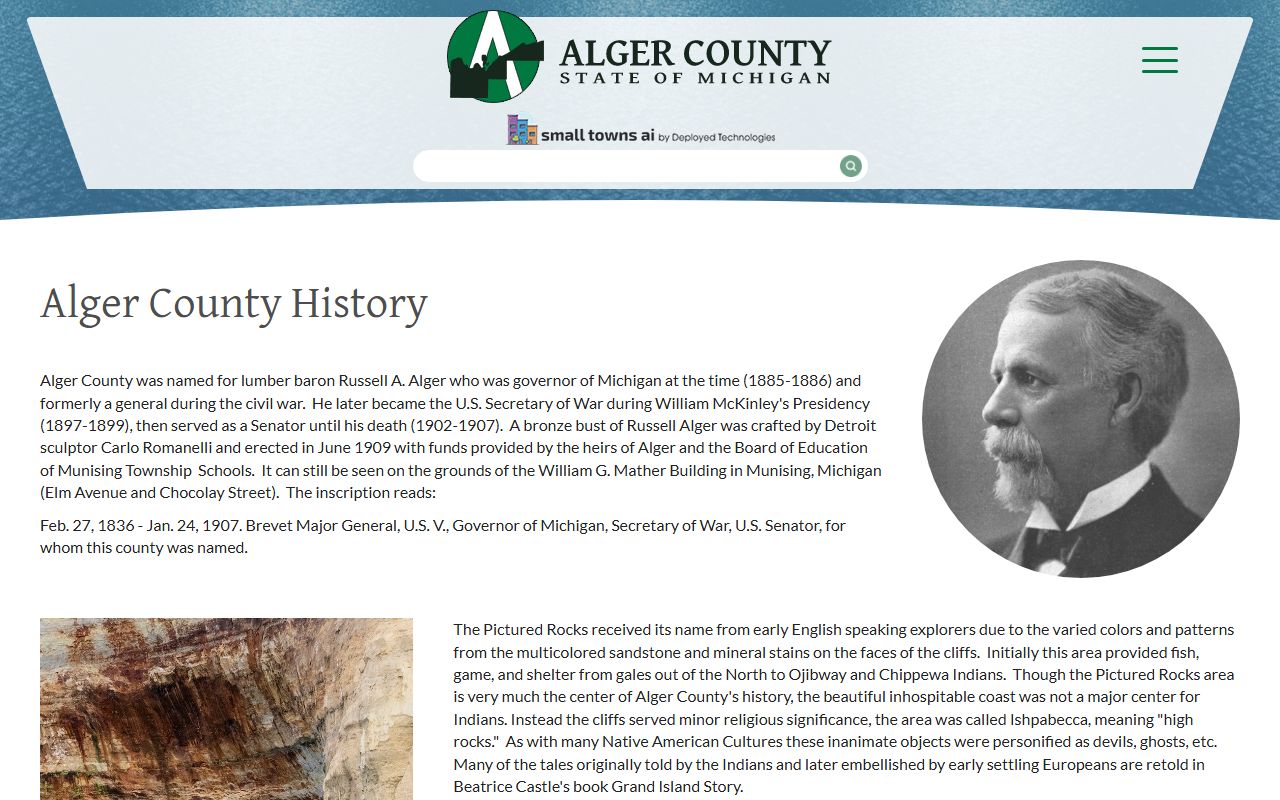
The county history page ties the courthouse story to the county's early growth. Lumber, fishing, and the Pictured Rocks shoreline all shaped the young county.
An archived version of that same history keeps the older narrative online. It repeats the seat-and-courthouse account that anchors the county's record system today.
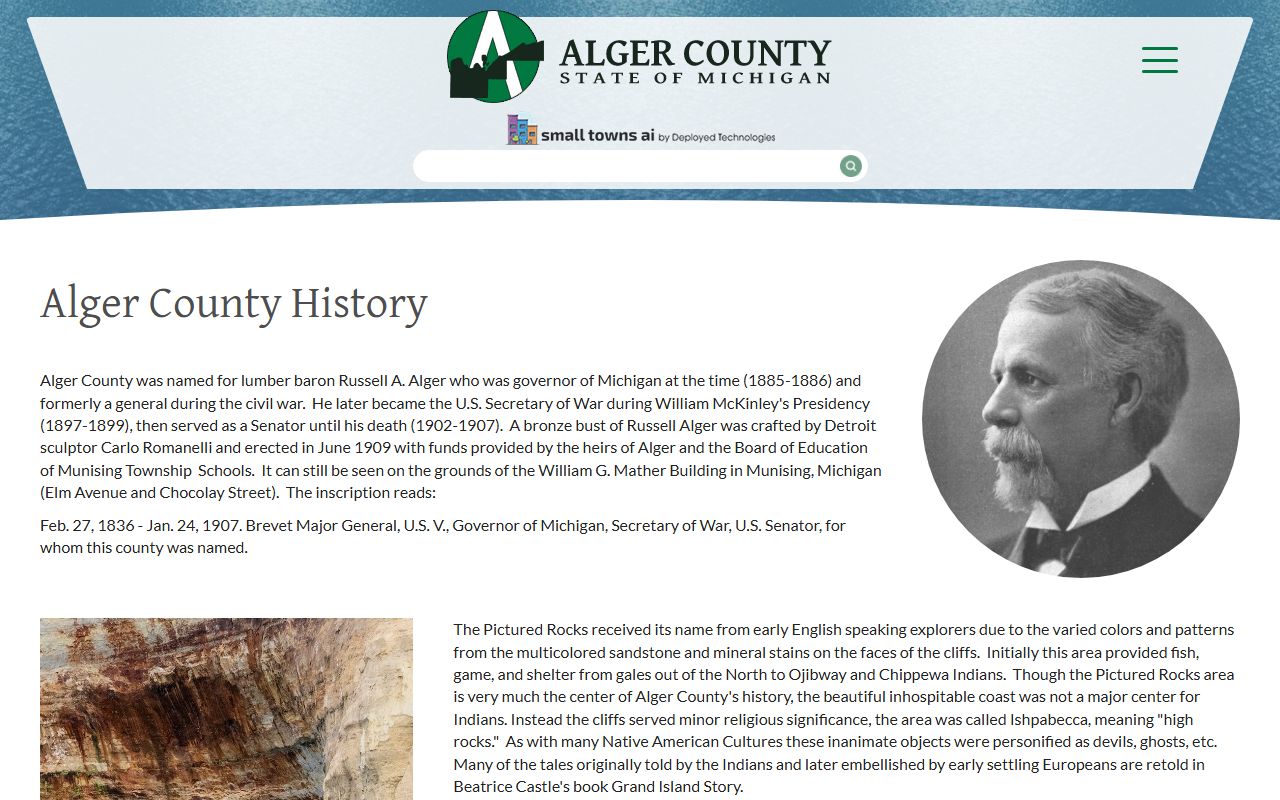
The archived county history confirms the 1901 move and the seat at Munising. Those facts frame why the courthouse holds the records it does.
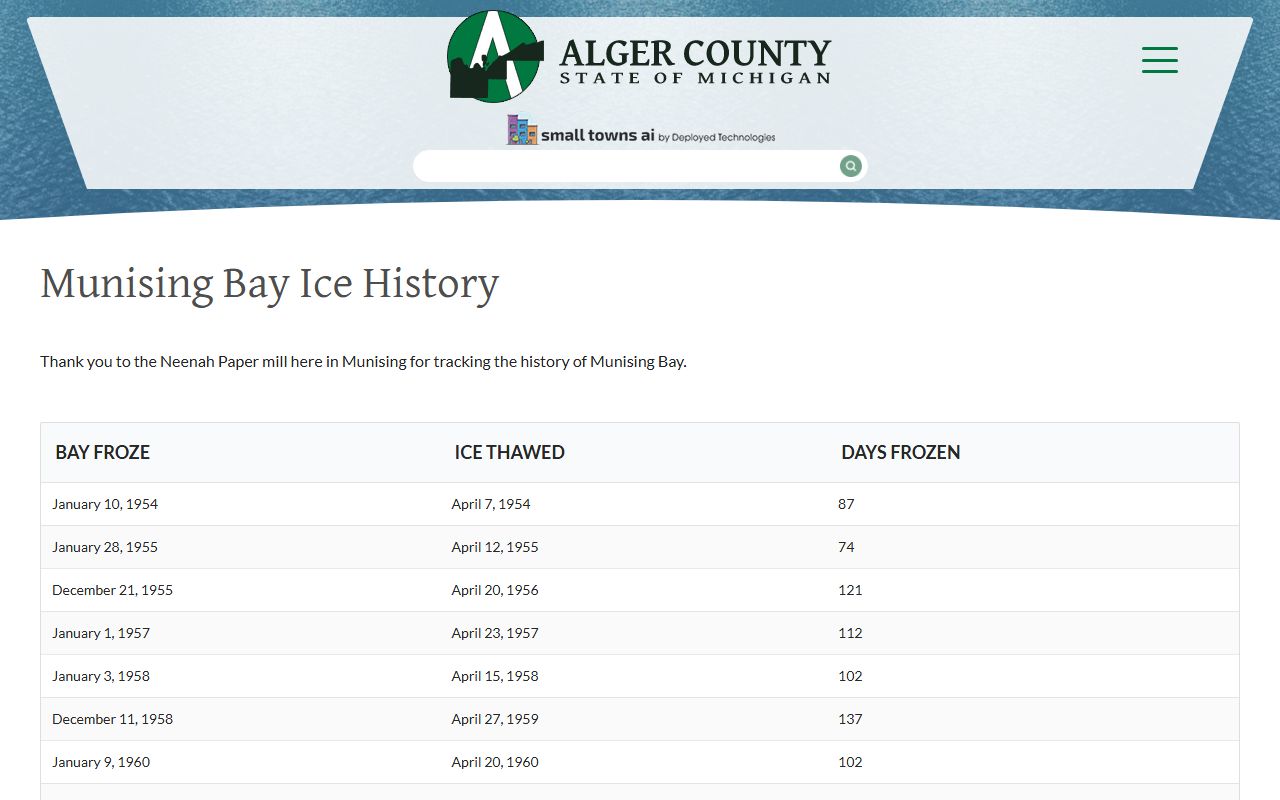
Local color runs deep in the harbor town. The Munising Bay ice history reflects the weather and water that still shape county life and courthouse rhythm.
Alger County Courthouse Contact Information
The main courthouse complex holds most court and clerk functions. The circuit court, district court, probate court, friend of the court, prosecuting attorney, and clerk all use one address. The sheriff is the main office kept apart. Both contact cards appear below.
Alger County Courthouse
101 Court Street
Munising, MI 49862
(906) 387-2076
Mon to Fri, 8:00 a.m. to 4:00 p.m.
Alger County Sheriff's Office
101 E. Varnum Street
Munising, MI 49862
(906) 387-4444
Open 24 hours, 7 days a week
County offices answer at extension 1, and the courts answer at extension 2. The probate and family court keeps its own line at (906) 387-2080. The clerk and register of deeds can be reached at (906) 387-7067 for vital records and marriage licenses.
Frequently Asked Questions
Where do I search for Alger County Court cases?
Start with the Michigan Courts case search or the MiCOURT case search. Both let you look up cases by party name or case number and filter by lower court. The public view covers case number, party names, and case history. For a full file or older paper record, contact the clerk or the court that opened the case.
Are Alger County court records public?
Most are public unless a rule or order restricts them. Court files follow Michigan court rules, not FOIA. County office records, such as clerk files, follow the state FOIA law. Juvenile, adoption, mental-health, sealed, and set-aside records stay closed or come back only in a redacted form.
What is the difference between the district and circuit courts?
The 93rd District Court handles misdemeanors, traffic, small claims, evictions, and civil suits up to $25,000. The 11th Circuit Court handles felonies after bindover, large civil cases, and family division matters. Bindover is the transfer of a felony from district court to circuit court after a preliminary examination.
How do I get a certified marriage or birth record?
The county clerk and register of deeds handles certified vital records. The first certified copy costs $15, and each added copy of the same record costs $5. Requests can be made in person, by mail, or online with a signed form and a photo ID. Birth records are not open to the general public and follow eligibility rules.
Does Alger County post an online jail roster?
The sheriff does not publish an online roster on the county pages. For sentenced state offenders, parolees, and probationers, the Michigan OTIS system is the public tool. For county jail booking or bond questions, contact the sheriff's office or the jail administrator directly.
How do I clear or expunge a record in Alger County?
Michigan calls it a set-aside. First confirm the record is eligible under state law. Then file the set-aside paperwork with the sentencing court, serve notice on the prosecutor, and attend any hearing. If the court grants it, the record is set aside and no longer treated as an ordinary public criminal record.