
Criminal Court Records in Alger County
A criminal court record is the case file a court opens once charges are filed against a person. In Alger County, the clerk of court keeps that file for the life of the case. It holds every paper the court receives and every order the judge signs. The file starts with the charging document. It ends with the disposition and, when there is a conviction, the sentence. Each entry is dated and logged on the docket, which is the running list of events in a case. That docket is the backbone of the whole record.
Criminal cases in Alger County split between two trial courts. The 93rd District Court hears misdemeanors, which are lesser crimes with jail terms of up to one year. It also holds the first appearance and the preliminary exam in felony matters. The 11th Judicial Circuit Court takes felonies once they are bound over, or transferred, from the district court. The most serious cases and their trials live there. Appeals move up to the Michigan Court of Appeals and then the Michigan Supreme Court. Charges are brought by the Alger County Prosecutor's Office, the county's charging authority.
The county spells out how charges begin on the Alger County Prosecutor's Office about page.
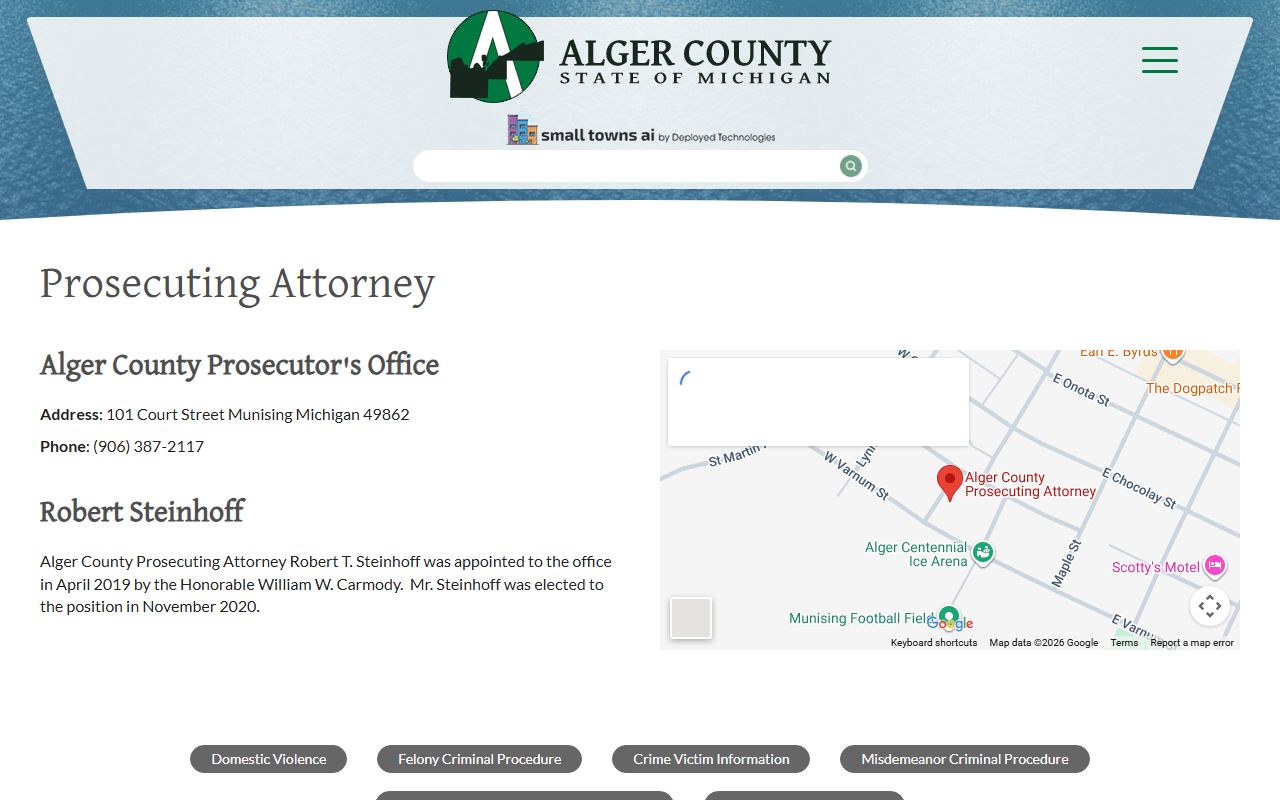
Prosecutor Robert T. Steinhoff leads that office at 101 Court Street in Munising. No criminal warrant issues in the county without the prosecutor's approval, so the charge stage sits at the very front of the record.
How to Search Alger County Criminal Records
Most Alger County criminal court records are searched through Michigan's statewide case tools. The state runs MiCOURT, an online case search that covers trial and appellate courts. The county circuit court page links straight to it. The public view is not a full document library. It shows the case number, party names, and case history rather than scanned copies of every filing.
- Open the Michigan Courts case search portal at courts.michigan.gov.
- Search by the defendant's name or the case number.
- Narrow by court, such as Alger Circuit Court or the district court, and by date.
- Open the matching case to read the docket, charges, and disposition.
- Request a certified copy from the clerk of court when you need an official record.
Some criminal history sits above the county level. The Michigan Courts case search reaches appellate opinions and orders, so an appeal in an Alger County case can surface there. Federal criminal matters are separate. Those go through the U.S. District Court for the Western District of Michigan and are searched on PACER. For older or non-digitized files, the clerk's office is the fallback.
Note: Michigan court records are not FOIA records, so public web views stay limited to case number, party names, and case history rather than full document images.
Stages of an Alger County Criminal Case
A criminal case moves through set stages, and each one leaves a mark on the record. The path starts with the charge and ends with a sentence or a dismissal. Reading the docket in order shows how the case traveled. The prosecutor sets the pace early, since charges must be authorized before a case can open.
Case flow: Charges Filed › Arraignment › Pretrial / Motions › Plea or Trial › Disposition › Sentencing
| Stage | What Happens |
|---|---|
| Arraignment | The defendant hears the charges, learns their rights, and enters a first plea. The judge sets bond at this point. |
| Pretrial / Motions | Lawyers trade evidence and file motions. A felony gets a preliminary exam to test probable cause before bindover. |
| Plea or Trial | The case ends in a plea deal or goes to trial before a judge or jury. |
| Sentencing | After a plea or a guilty verdict, the judge orders the penalty. It can include jail, probation, fines, or restitution. |
The prosecutor breaks down the lower-court path on the Alger County misdemeanor criminal procedure page.
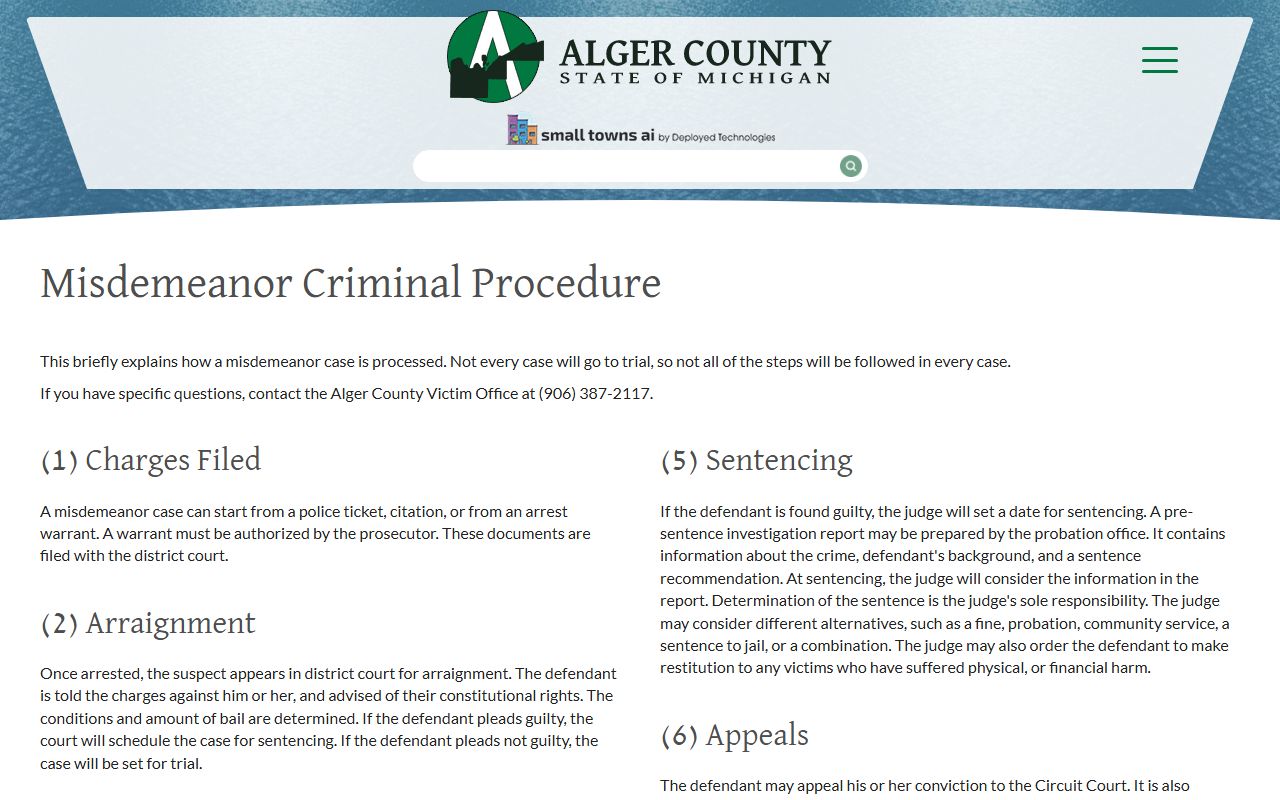
A misdemeanor can start from a police ticket, a citation, or an arrest warrant. From there, the district court carries it from arraignment through sentencing, and every step lands on the docket.
What Alger County Criminal Records Show
Once a case opens, the file fills with named fields. Each field answers a plain question about the case. Together they let a reader follow the matter without pulling every paper. The table below lists the fields most Alger County criminal court records display.
| Field | What It Shows |
|---|---|
| Case Number | The unique ID the court assigns when the file opens. |
| Filing / Charge Date | The date charges were filed and the case began. |
| Defendant / Parties | The accused person and the prosecuting side. |
| Charges | Each count with its statute and severity, whether misdemeanor or felony. |
| Arraignment | The first appearance where the charges are read and a plea is entered. |
| Bond | The money or promise set to secure the defendant's return to court. |
| Plea | Guilty, not guilty, or no contest as entered by the defendant. |
| Disposition | The outcome of each charge, such as convicted, dismissed, or acquitted. |
| Sentence | The penalty the judge ordered after a plea or verdict. |
| Probation | Any term of supervision set in place of or after custody. |
The charge field carries the most weight. It names the statute, such as a section of Michigan law, and the severity of the crime. A felony charge in Alger County passes through the district court first, then moves to circuit court after the preliminary exam.
The county lays out that route on the Alger County felony criminal procedure page.
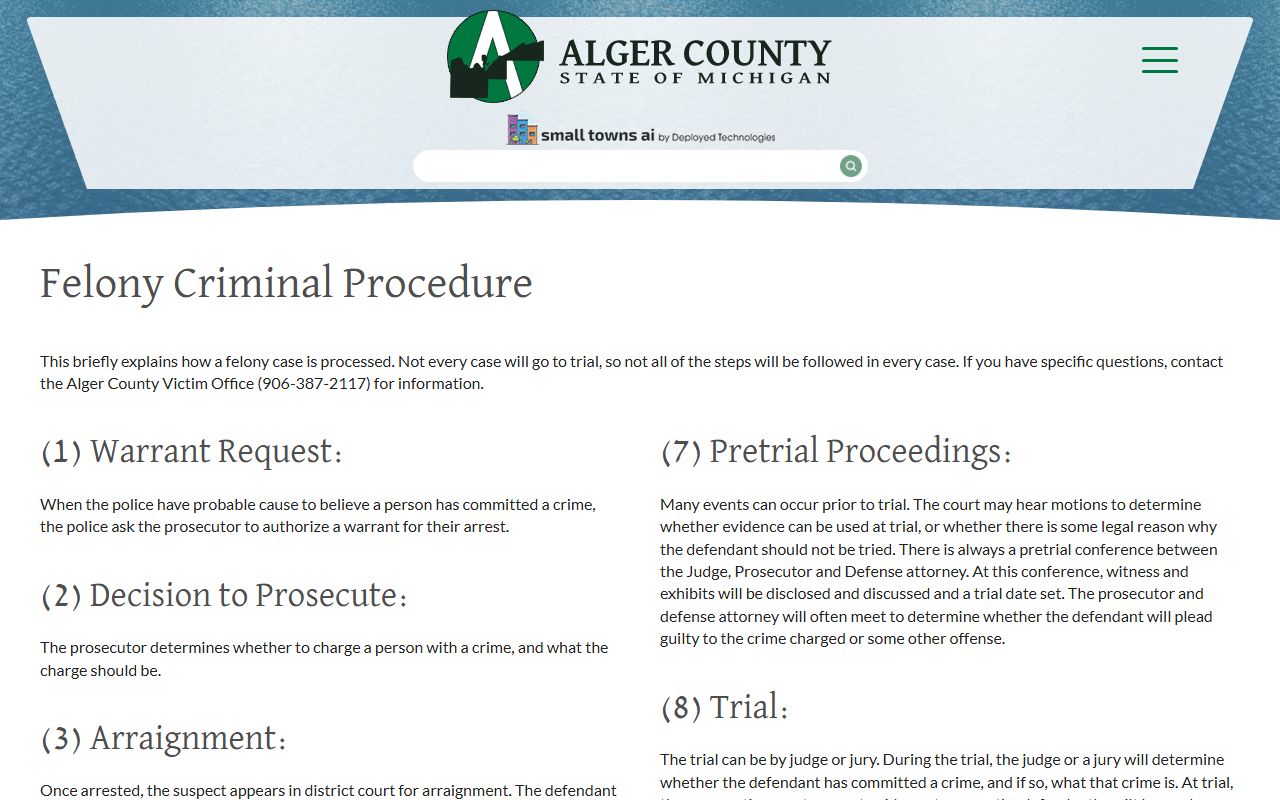
Bindover is the formal transfer from the 93rd District Court to the 11th Judicial Circuit Court. It happens once a judge finds probable cause at the preliminary exam, and the record then continues in the higher court.
Charges vs. Convictions
A charge is not a conviction, and the record keeps the two apart. A charge is only an accusation the prosecutor files. A conviction is a finding of guilt by plea or verdict. Many Alger County criminal court records show charges that were later dropped, reduced, or dismissed. Some show an acquittal, which means the court found the person not guilty.
| Charge | Conviction | |
|---|---|---|
| Stage | Accusation | Verdict or plea |
| Burden of Proof | Probable cause | Beyond reasonable doubt |
| Meaning | Filed by the prosecutor | Proven in court |
| Can Change | Amended, reduced, dropped | Set aside only by court order |
| Public Record | Yes | Yes |
The charge itself has a life of its own inside the case. It can be amended, cut through a plea, or dismissed before trial. The Alger County arrest records and court charges page follows those charge details more closely. Reading the disposition next to the charge shows the real outcome.
Note: A dropped or dismissed charge still appears in the court record unless it is later set aside, so the file can list outcomes that never became convictions.
Reading Alger County Criminal Dispositions
Disposition is the outcome of each charge, and it is the field most readers want. Common entries are guilty, not guilty, dismissed, and nolo contendere, which means no contest. A no contest plea accepts the penalty without admitting the facts. Deferred entries hold judgment while the defendant meets set terms.
The sentence sits right next to the disposition. It spells out the penalty the judge ordered. That can be jail time, probation, a fine, or restitution, which is money paid back to victims. Probation means supervision in place of, or after, time in custody. An Alger County criminal court record reads clearly once the charge, disposition, and sentence line up together.
Some case types carry extra steps, as the county shows on its Alger County domestic violence prosecution page.
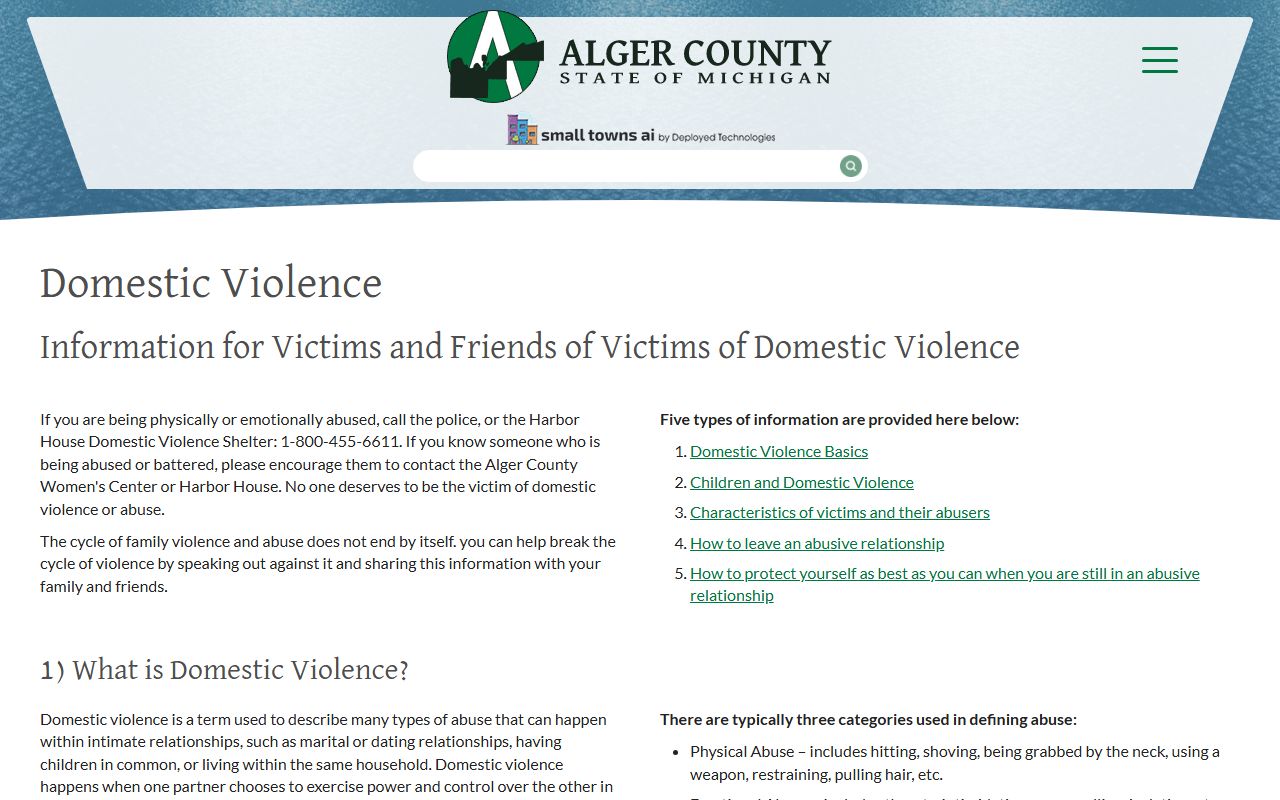
Victim services run alongside these cases. Coordinator Kathleen Lindquist keeps named victims updated on hearings and outcomes, and those steps can appear in the case history.
Sealed vs. Expunged Records
Not every criminal record stays open forever. Michigan law lets some people clear a past case. Sealing and expungement are the two paths, and they are not the same. The difference decides who can still see the record.
| Sealed | Expunged | |
|---|---|---|
| Visibility | Hidden from public | Set aside; no longer an ordinary public record |
| Law Enforcement | Limited access | Very limited |
| Eligibility | By court order or rule | Under MCL 780.621, Michigan's set-aside statute |
Expungement in Michigan is called a set-aside. It runs under MCL 780.621. Once a court grants it, the record no longer shows up as an ordinary public criminal record. The petition is filed with the sentencing court, and the prosecutor gets notice. A clerk can point to the filing path but cannot give legal advice.
Note: A set-aside under Michigan law is not the same as a sealed file, since a set-aside record no longer appears as an ordinary public criminal record at all.
Public Access to Alger County Records
Alger County criminal court records are public by default. Michigan court rules, not the state FOIA law, control access to case files. A file stays open unless a statute, court rule, or judge's order restricts it. That means most adult criminal cases can be viewed or copied.
Key Statutes:
Michigan Court Rule 8.119 - Trial court records are public unless restricted, and court records are not treated as FOIA records.
Michigan Compiled Laws § 780.621 - The state set-aside statute lets eligible people clear a criminal record from public view.
For records that are old, sealed, or missing from the online system, the fallback is a direct request to the clerk of court. The full range of case files also runs through the wider Alger County court records channels. A written request to the office that holds the file is the surest path when the portal shows nothing.
Background Check Considerations
A quick name search is not a background check. Employers and landlords that run formal checks must follow the federal Fair Credit Reporting Act. That law sets rules for accuracy, notice, and consent. A casual look at a court record does not meet those standards. For a hiring or housing decision, a compliant screening service is the right tool.
Important: Records found through public search tools cannot be used for FCRA-regulated decisions such as employment, credit, housing, or insurance screening.
Restricted Alger County Criminal Records
Some Alger County criminal court records are closed to the public. Juvenile cases top the list. The county's probate and family court handles juvenile delinquency, and those files stay confidential. Sealed and expunged cases also drop out of public view. Ongoing investigations and certain sensitive records can be withheld by the court as well.
Anyone facing charges who cannot afford a lawyer can turn to the Alger County Defender's Office.
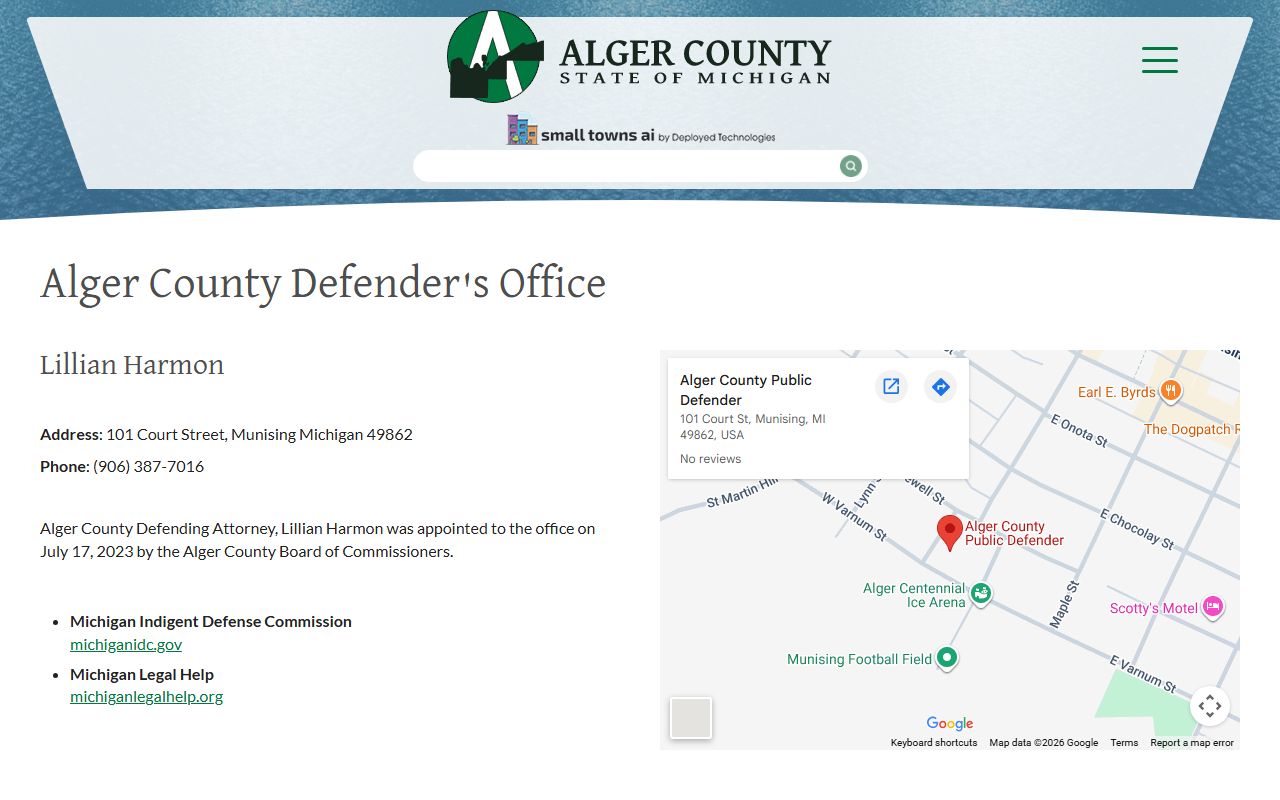
Lillian Harmon leads that office at 101 Court Street in Munising. The county board appointed her in July 2023 to represent defendants who qualify, and her filings become part of the same case record.
Access limits protect people and cases, not the county's convenience. A juvenile record stays sealed to give young people a fresh start. A set-aside record drops out of ordinary public searches under state law. When a search returns nothing, the case may simply be one the court cannot share.